If It’s Wrong in Portsmouth, It’s Wrong in the Countryside

Earlier this month, Hampshire and Isle of Wight Constabulary announced a crackdown on masked protesters. Using new powers under the Crime and Policing Act, officers will stop people at protests from hiding their faces. The trigger was masked demonstrators at anti-migrant protests in Dover and Portsmouth.
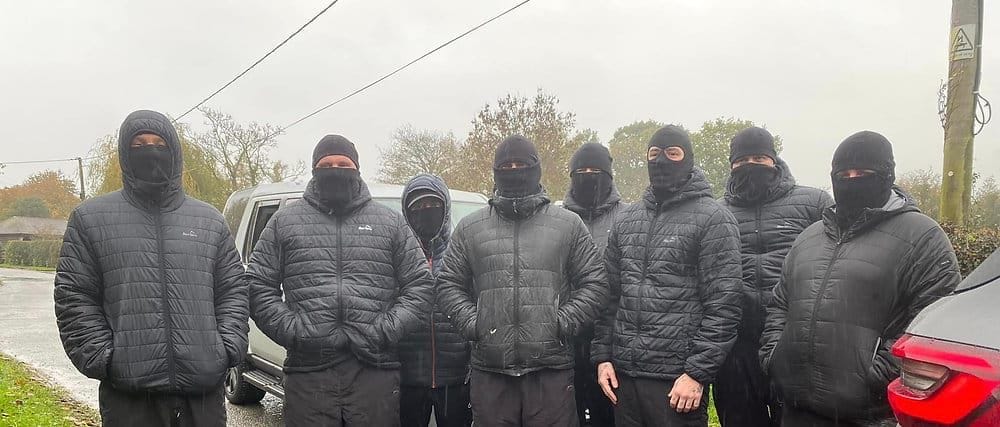
However, for the hunting community, masked protesters are nothing new. Hunt saboteurs have been turning up in balaclavas for years.
An all too familiar scene in Cheshire: violent masked saboteurs disrupting the peace
Same masks, different treatment
Saboteurs arrive dressed in black, their faces covered, to disrupt a lawful activity at the heart of rural life. Many claim to act peacefully, but there have been many cases involving violence. One example is Paul Allman of the Stockport Monitors, who was jailed for 20 weeks in 2023 after assaulting two supporters of the Wynnstay Hunt in Cheshire. In sentencing, District Judge John McGarva described Allman as a "danger to the public" and noted his history of violent offending.
Where violence at hunts is so well documented, the power to require saboteurs to remove their masks should be used to prevent it - not left on the shelf until someone gets hurt.
Yet when immigration protests make the headlines, the police seem to find that resolve very quickly. When it comes to the countryside, it appears much harder to find.
The power is there. It’s just not being used.
This isn't about a gap in the law. Police can already require masked individuals to remove face coverings once a senior officer authorises it in an area where offences are expected. The problem is that these powers are almost never used against saboteurs.
In 2016, Countryside Alliance research found that the provision had been used against hunt saboteurs just once in the previous three years, by Derbyshire Police. Over the same period, ten other forces used it against political protesters and football supporters.
Ten years on, not much has changed.
“Two-tier policing”
Former defence secretary Ben Wallace put it bluntly in 2024. He said there was "a sense of two-tier policing" in the countryside, with saboteurs' "thuggery" going unchallenged while hunts faced constant scrutiny.
Oliver Hughes of the British Hound Sport Association made the same point more gently. Saboteurs "regularly turn up clad in black, wearing balaclavas, looking very threatening," he said, "and it's felt they don't get quite as much pressure or inspection from the police as the hunts do."
Two years on, the police have shown in Hampshire how quickly they can act against masked protesters. The same balaclavas at a hunt meet still don't seem to prompt the same response.
More evidence of sab violence perpretated by people in masks.
“We’re only there to stop illegal hunting”
That’s the saboteurs’ standard defence, but it doesn’t explain everything that happens in the field.
Take Dean Cain, a sab with the South Notts group who is rarely seen without his black balaclava. During the 2025 season, hunt supporters described being singled out by Cain and fellow saboteurs when on their own. One supporter said three of them cornered her, forcing her to cross a field and walk about a mile to get away.
Whatever the stated purpose of hunt sabbing, behaviour of this kind goes beyond simply observing what is happening in the field. And when those involved conceal their identities, it becomes harder to hold them to account.
Consistency is key
If a mask is unacceptable on a street in Portsmouth, it is unacceptable at a meet in Cheshire. Hampshire has shown the police can act quickly when they want to. The countryside is still waiting for them to want to.